
Pashto children's books can make learning Pashto more natural, enjoyable, and meaningful for children. Instead of treating the language only as a school subject, books introduce Pashto through stories, characters, pictures, conversations, poems, and everyday situations. Children can gradually become familiar with Pashto vocabulary, sentence patterns, pronunciation, and cultural expressions while enjoying an age-appropriate story.
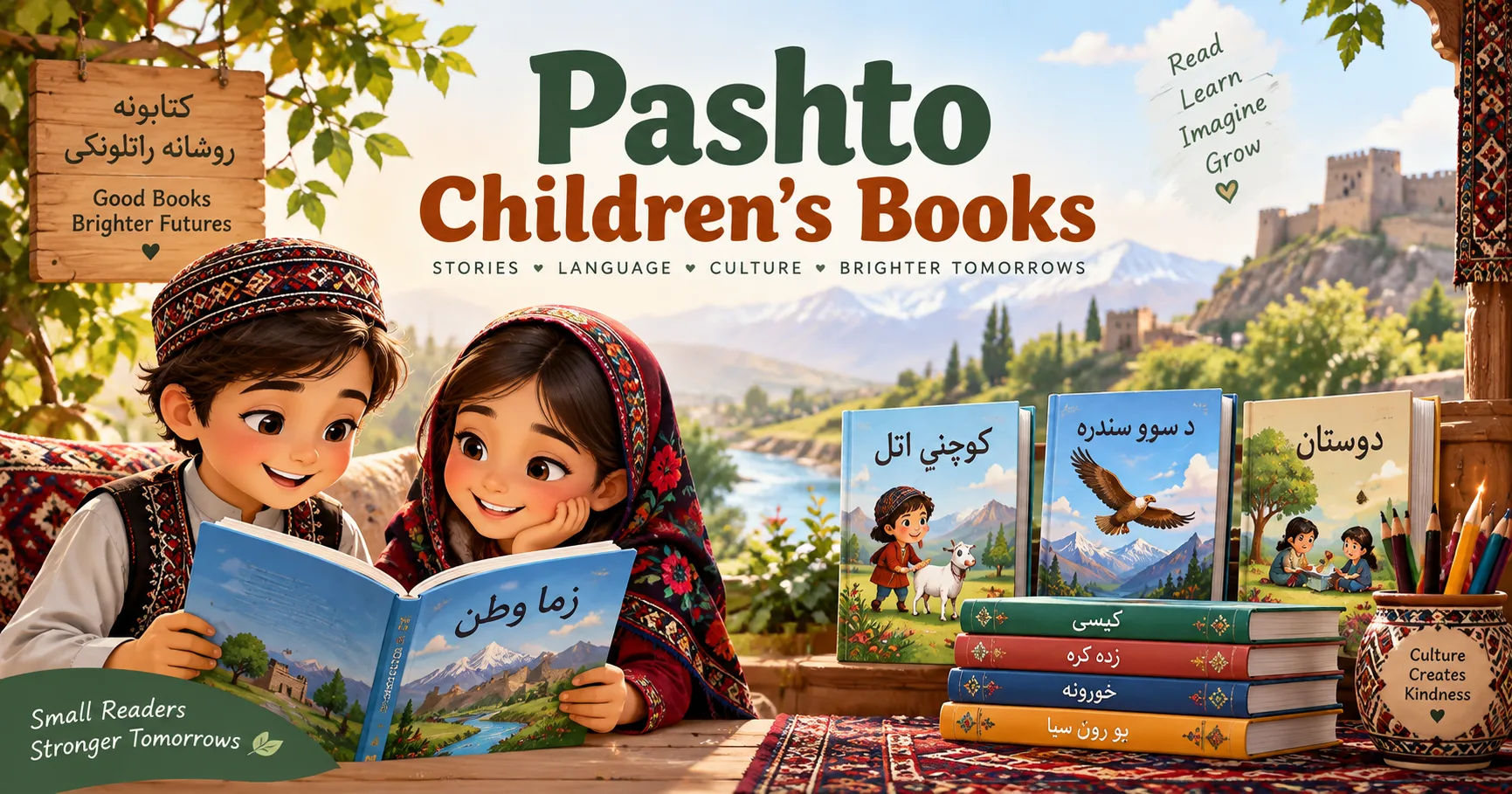
For children who already hear Pashto at home, these books can strengthen their existing language skills. For beginners, they can provide a gentle introduction to common words and phrases. Regular reading also gives children repeated exposure to the language, which can help them remember new vocabulary more easily.
Why Reading Is Important for Learning Pashto
Language learning becomes easier when children encounter the same words and sentence structures repeatedly. Reading provides this repetition in a meaningful context.
A child may forget a vocabulary word when learning it from an isolated list. However, seeing that same word several times in a story can help the child understand how it is actually used.
Books also expose children to language that may not appear in everyday conversations. They can introduce descriptive words, expressions, questions, commands, and complete sentences.
Stories Make Language Meaningful
Children naturally want to understand what happens next in a story. This curiosity encourages them to pay attention to the words around them.
For example, if a character is looking for a lost object, children can understand vocabulary related to searching, places, family members, and objects through the events of the story.
This approach connects vocabulary with meaning rather than asking children to memorize disconnected words.
Repetition Supports Memory
Children's books often repeat important words and phrases. Repetition is valuable because young learners need to encounter vocabulary multiple times before it becomes familiar.
A story might use the same greeting, family term, animal name, or action word several times. Each repetition gives the child another opportunity to recognize and understand it.
How Pashto Children's Books Build Vocabulary
Vocabulary is one of the first areas in which reading can make a noticeable difference. A well-designed children's book introduces words gradually and places them in understandable contexts.
Children may learn words related to family, school, food, animals, nature, clothing, emotions, and daily activities.
Learning Words Through Context
Context helps children guess the meaning of unfamiliar words. Pictures and surrounding sentences can provide additional clues.
Suppose a story describes a character eating a particular food. Even if the child does not know every word in the sentence, the illustration and the action can help explain what is happening.
This makes vocabulary learning less intimidating.
Expanding Everyday Vocabulary
Good Pashto children's books can introduce vocabulary beyond the words children commonly hear at home.
A child may know basic family words but have limited vocabulary related to weather, transportation, nature, emotions, or school activities.
Reading different stories allows children to encounter these topics naturally.
Learning Synonyms and Descriptive Language
As children progress, books can introduce different ways of describing the same idea.
They can learn words that express size, color, movement, feelings, and personality. This gradually makes their spoken and written Pashto more expressive.
Improving Pashto Sentence Structure
Learning individual words is not enough to become comfortable with a language. Children also need to understand how words work together in sentences.
Books provide countless examples of naturally formed sentences.
Seeing Complete Sentences
A child who reads regularly begins to recognize familiar sentence patterns.
For instance, repeated questions and answers in stories can help children understand how conversations are structured. They can gradually become familiar with how statements, questions, descriptions, and responses are formed in Pashto.
Developing Grammar Naturally
Formal grammar lessons can sometimes feel difficult for young learners. Stories offer another way to encounter grammar.
Children see verbs, nouns, adjectives, pronouns, and other grammatical elements being used repeatedly.
They may not be able to name every grammatical rule, but they can gradually develop an intuitive understanding of what sounds natural.
Helping Children Improve Pronunciation
Reading aloud can support pronunciation when a child has access to a fluent Pashto speaker, teacher, parent, or audio version of a book.
A child can listen to a sentence and then repeat it.
This practice helps connect written words with their spoken forms.
Reading Aloud at Home
Parents can take a few minutes each day to read a story aloud. The child can follow the text while listening.
Afterward, the child can read a short section independently.
This creates a simple routine without turning reading time into a stressful lesson.
Practicing Difficult Sounds
Pashto contains sounds that may be unfamiliar to children who mainly speak another language.
Reading aloud provides repeated opportunities to practice these sounds. A parent or teacher can gently correct pronunciation and allow the child to try again.
The goal should be confidence and gradual improvement rather than perfection.
Developing Listening and Speaking Skills
Although books are written materials, they can also support spoken Pashto.
Parents and teachers can turn reading into a conversation.
After reading a page, they can ask the child what happened, who the characters were, or what might happen next.
Asking Simple Questions
Questions encourage children to use Pashto actively.
For younger learners, questions can be very simple. Older children can explain why a character behaved in a certain way or describe an event in their own words.
This transforms passive reading into active language practice.
Retelling Stories
Retelling is an especially useful activity.
After finishing a story, the child can explain the main events in Pashto. They do not need to reproduce the original text.
Using their own words helps them practice vocabulary, sentence construction, and speaking confidence.
Making Pashto Learning More Enjoyable
Children are more likely to continue learning a language when the experience feels enjoyable.
Books can provide entertainment while supporting language development at the same time.
Interesting Characters Encourage Reading
Children often become attached to fictional characters. They may want to know what happens to a clever child, friendly animal, adventurous family, or humorous character.
That interest creates a natural reason to continue reading Pashto.
Humor and Adventure Increase Engagement
Funny situations, mysteries, adventures, and imaginative stories can keep children interested.
When children are focused on understanding a story, they may learn vocabulary without feeling that they are completing a traditional language exercise.
Connecting Language With Pashto Culture
Language is closely connected with culture. Children's literature can introduce children to cultural ideas, traditions, family relationships, local settings, and forms of expression.
This is particularly useful for children growing up in multilingual environments.
Learning Cultural Expressions
Books can expose children to greetings, respectful language, common expressions, and culturally familiar situations.
Children can learn not only what a word means but also when and how it is used.
Preserving Family Language
For families living away from Pashto-speaking communities, reading can help maintain a connection with the language.
Parents and grandparents can use books as a starting point for conversations about family traditions and experiences.
This can make language learning a shared family activity.
How Parents Can Use Pashto Children's Books at Home
Parents do not need to create complicated lessons. A consistent reading routine can be enough to provide valuable exposure.
Even 15 to 20 minutes of reading several times a week can create opportunities for practice.
Choose Books at the Right Level
A book should not be so difficult that the child cannot understand the basic story.
At the same time, it should introduce some new vocabulary.
A useful book combines familiar language with manageable challenges.
Use Pictures as Learning Tools
Pictures can help children understand unfamiliar vocabulary.
Parents can point to objects and ask children to name them in Pashto. They can also ask children to describe what they see.
This turns illustrations into additional language-learning resources.
Discuss New Words
Parents can select a few unfamiliar words from each story.
Instead of explaining dozens of words at once, they can focus on a small number and use them in simple sentences.
Later, the same words can be reviewed through conversation or another story.
How Teachers Can Use Children's Books
Teachers can use literature as a foundation for several language activities.
A short story can support reading comprehension, vocabulary practice, speaking exercises, and writing assignments.
Reading and Comprehension
Students can read a passage and answer questions about its characters, setting, and events.
Questions can begin with simple factual details and gradually become more analytical.
Vocabulary Activities
Teachers can ask students to identify unfamiliar words and determine their meanings from context.
Students can then use those words in their own sentences.
Creative Writing
After reading a story, students can write an alternative ending or create a short story featuring similar characters.
This encourages them to use Pashto vocabulary independently.
Choosing Effective Pashto Children's Books
Not every children's book will work equally well for every learner.
Parents and teachers should consider the child's age, reading ability, interests, and current Pashto skills.
Look for Clear Language
Books intended for learners should use language that is understandable without becoming overly simplistic.
Short sentences can be particularly helpful for beginners.
Consider Illustrations
Pictures are valuable because they provide visual context.
A child who encounters an unfamiliar word can often use the illustration to understand what is happening.
Choose Different Types of Stories
A varied reading collection can expose children to different vocabulary and writing styles.
Families can include folk stories, modern stories, poems, educational books, adventure stories, and books about everyday life.
Digital and Printed Pashto Books
Children can learn from both printed and digital books.
Printed books can provide a distraction-free reading experience and allow children to physically interact with the pages.
Digital books may offer convenient access, especially for families who have difficulty finding Pashto-language material locally.
Some digital resources may also include audio, which can be particularly helpful for pronunciation and listening practice.
The important factor is not simply the format. The quality, language level, and consistency of reading matter more.
Creating a Simple Pashto Reading Routine
A reading routine does not have to be complicated.
Parents can choose a regular time, such as after homework or before bedtime. The child can read a few pages and discuss the story afterward.
Older children can read independently and explain the story to a parent.
Combine Reading With Speaking
After reading, families can continue the conversation in Pashto.
They might discuss the characters, setting, favorite part, or lesson of the story.
This gives children an immediate opportunity to use newly learned words.
Review Without Pressure
Children do not need to memorize every word from every book.
Instead, important vocabulary can be reviewed naturally in later conversations.
If a child makes mistakes, corrections should be gentle and encouraging. Confidence is an important part of becoming a stronger language learner.
Common Challenges When Using Pashto Books
Some families may find it difficult to establish a regular Pashto reading habit.
Children may initially prefer books in another language, especially if they are more comfortable reading that language.
Parents can respond by choosing subjects that already interest the child.
Difficulty With Pashto Script
For children who are learning to read Pashto, the script may initially require extra practice.
Parents can begin with books that have large, clear text and strong visual support.
Reading aloud together can make the process easier.
Limited Access to Books
Depending on where a family lives, finding suitable Pashto literature can sometimes be challenging.
Families may explore libraries, bookstores, educational publishers, schools, and reputable digital resources.
The goal is to build a small but useful collection that the child actually enjoys reading.
Long-Term Benefits of Reading Pashto
Regular exposure can produce benefits beyond vocabulary.
Children can gradually become more comfortable understanding written Pashto and expressing their thoughts.
Reading can also strengthen their connection to family and cultural heritage.
As their skills improve, they may be able to move from very simple stories to longer and more complex books.
This creates a progression in which reading material grows alongside the child's language ability.
Conclusion
Pashto children's books provide a practical and engaging way for children to develop their Pashto language skills. Through stories, illustrations, dialogue, repetition, and age-appropriate vocabulary, books can introduce language in a context that children can understand and enjoy.
They can help build vocabulary, improve sentence structure, support pronunciation, strengthen listening and speaking practice, and increase confidence. Books can also connect children with Pashto culture, traditions, and family language.
The most effective approach is usually consistent rather than complicated. Parents can read with children, discuss stories, explain a few new words, and encourage children to retell what they have read. Teachers can use stories for comprehension, vocabulary, speaking, and creative writing activities.
With regular exposure and enjoyable reading material, children can gradually move from recognizing individual Pashto words to understanding sentences, following stories, and communicating more confidently. In this way, books become more than reading material. They become a natural bridge between children, language, family, and culture.